
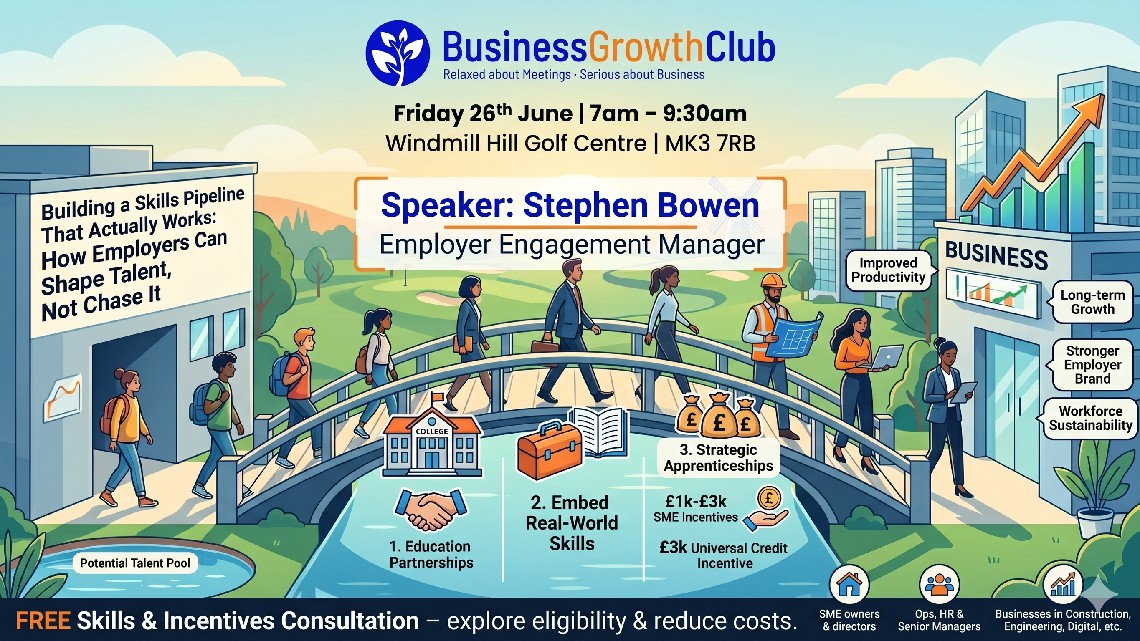
'10 Minute Tip' by Stephen Bowen - Employment Engagement Manager - 7am until 9:30am
Stephen Bowen is an Employer Engagement Manager at the South Central Institute of Technology part of the Milton Keynes College Group. He has extensive experience working with businesses across multiple sectors to address skills gaps, workforce challenges, and future talent needs.
He specialises in building strategic partnerships between employers and education, helping organisations use apprenticeships, training, and early talent development as tools for growth rather than short term fixes.
Stephen works closely with business leaders to design practical, commercially focused skills solutions that deliver real value, improved productivity, and long term workforce sustainability.
Stephen works particularly well with
SME owners and directors
Operations, HR, and senior managers
Businesses experiencing recruitment or skills shortages
Sectors including construction, engineering, digital, business services, logistics, and professional services
Stephen will be offering all attendees
A free, no obligation employer skills and incentives consultation, where attendees can explore:
Which apprenticeship and hiring incentives they are eligible for
How to reduce recruitment costs using funded and incentivised routes
Practical next steps to build a sustainable skills pipeline aligned to their growth plans.

About the conversation:
Building a Skills Pipeline That Actually Works
How Employers Can Shape Talent, Not Chase It
Key Points Stephen Bowen Will Cover
1. Why employers struggle to recruit – and what’s really broken
Many employers are stuck in a reactive recruitment cycle: advertising roles, competing on salary, and hoping the “right” candidate appears. This approach ignores the root cause — a weak or disconnected skills pipeline.
Stephen will explain why traditional recruitment no longer works for many sectors and how smarter employers are shifting their focus upstream to influence skills development earlier while reducing recruitment cost and risk.
2. How employers can shape future talent through education partnerships
Colleges and training providers are not just places to “send learners” — they are strategic partners. Employers who engage properly can influence curriculum, embed real world skills, and develop job ready talent aligned to their business needs.
I’ll share practical ways employers can work with education without it becoming time consuming or bureaucratic, including how early engagement opens access to funded and incentivised talent routes.
3. Using apprenticeships as a growth tool and accessing the incentives available right now
Apprenticeships are often misunderstood or underused. When designed well, they can improve productivity, retention, leadership capability, and succession planning; not just fill entry level roles.
Stephen will also explain the current financial incentives available to employers, including:
£1,000 payment for employing apprentices aged 16–18, or 19–24 with an EHCP or who are care leavers
£2,000 SME incentive for new employees aged 16–24 who joined within the last three months
£2,000 Foundation Apprenticeship incentive for eligible young people, including those with an EHCP or from priority backgrounds
£3,000 Universal Credit incentive for apprentices aged 18–24 who have been on Universal Credit for 6+ months
Stephen will demonstrate how these incentives can significantly reduce hiring costs and make taking on new talent a commercially sound decision, not a gamble.
4. Turning engagement and incentives into commercial advantage
Businesses that invest in skills and understand how to access available incentives gain benefits beyond recruitment: stronger employer brand, improved retention, and better long term workforce planning.
Stephen will also demonstrate how combining education partnerships, apprenticeships, and incentives create a workforce strategy that is both financially supported and future proofed.
For small business owners, this session provides clear, up to date insight into how to recruit and develop talent while accessing financial incentives many employers are missing. You’ll understand what support is available, who is eligible, and how to avoid common mistakes.
For employed professionals and leaders, it offers practical knowledge on workforce planning, skills investment, and how to make better use of funded routes to bring new people into the business.
Stephen will provide a printed handout that includes:
Key takeaways from the session
A simple employer engagement framework
Contact details
A clear call to action